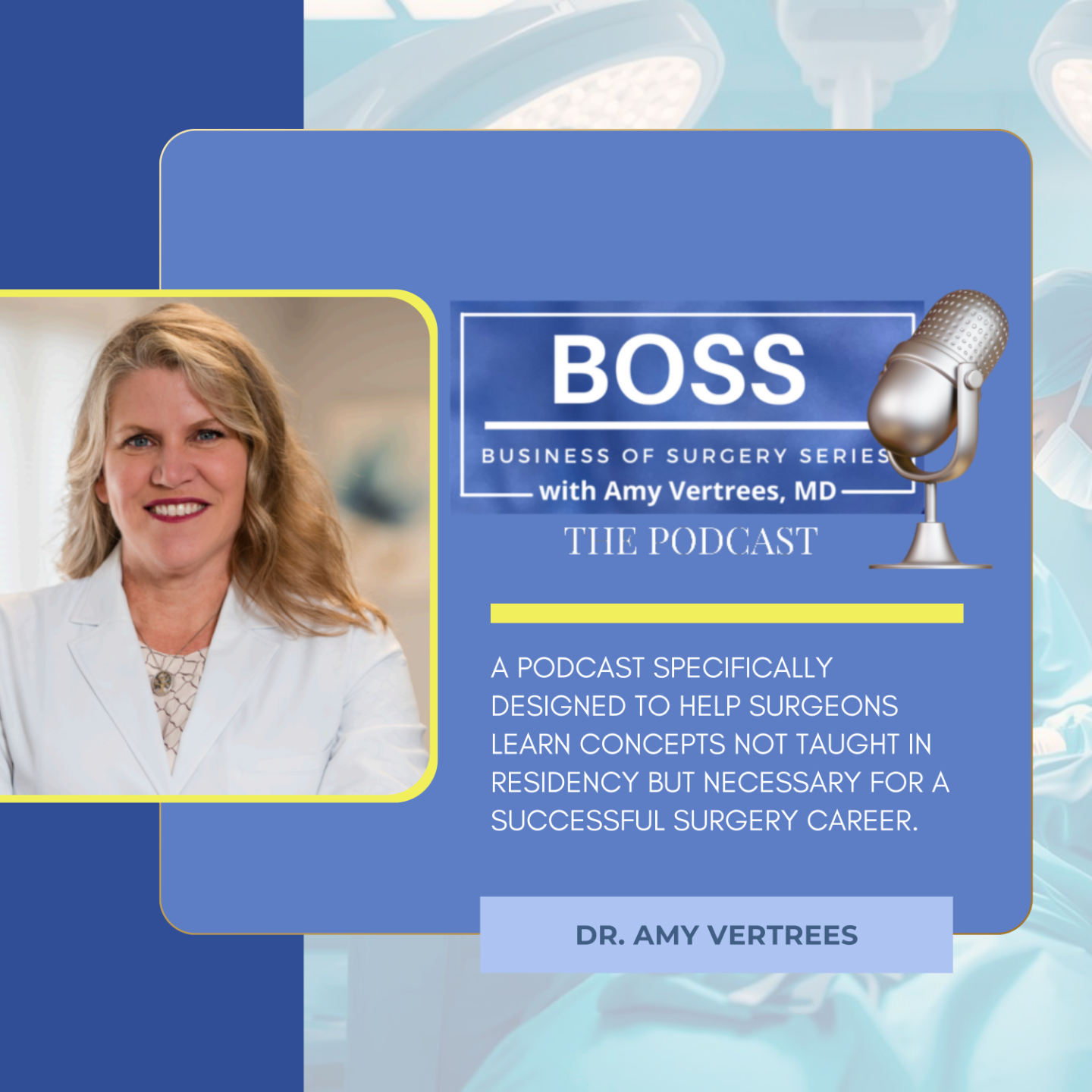
Welcome to the
The BOSS Business of Surgery Series Podcast
With Amy Vertrees, MD
Making Money Work For Us

Episode 23: Creating Wealthy-Minded Women Physicians
The latest BOSS podcast features Bonnie Koo, MD!
We talked about the entrepreneur journey, coaching, the importance of personal development, and of course money!
She is founder of Wealthy Mom, MD and the author of “Defining Wealth for Women (n.): Peace, Purpose, and Plenty of Cash.” Her book is what is missing in financial education - money mindset. Her book challenges money myths that many still think are true. She offers practical steps that allow us to start unraveling some of our thoughts about money. She teaches the opposite what other people think- she offers another way.
She shared the most important lesson there is about money: Your only limitation is your mind.
The problem is that we have been told stories about money that may not even be true. She challenges us to ask- is that really true? What if that myth is not true, and that is what is holding us back?
We often think that making money is trading time for money- that we must work more, see more patients. We can question traditional medicine and consider other paths available. We may have judgments about how we make money (like thinking some job is a “cop out”) that may be holding us back. She challenges the idea that there is a ceiling for how much money you can make.
Money brings up thoughts like corruption and greed. She challenged the idea that money changes who we are. What if money makes you more of who you already are? For example, with more money, you could be more generous.
She challenges the idea that saving is the only way to make money and debt is bad. If you think that debt is bad- you are missing an opportunity to build wealth. By leveraging low interest debt to higher paying investments, you could be making more money over simply saving money.
She works with women who feel like their spending is out of control. Overdesire is often the problem, but she teaches others how to retrain your brain. This is a teachable skill that starts with learning the ability to sit with an uncomfortable feeling
Dr. Bonnie Koo can be found at https://wealthymommd.com/

Episode 25: Preventing Burnout By Learning More About Money
The latest BOSS Business of Surgery Series podcast features Dr. Latifat Akintade, the MoneyfitMD. She coaches women physicians about money so they can burnout less. We had a great talk about how our thoughts and fears about money can hold us back. She had some great insights including:
- Separate the money we make from our value as a human. Money is a thank you for the work that we do, but it is not the measure of who we are. Unless we do that, we will never feel like we have enough.
- Simplifying the language of money shows us that it doesn’t have to be hard. And we don’t have to learn everything about money right away, or even learn everything there is to know.
- Recognize when we are feeling fear or shame about money, and that these come from thoughts that are holding us back (like money is hard, money is bad, I am too busy, I am greedy if I think about money, I should have learned all this already).
- When physicians have money, we do good things with it.
- We already have the tools to succeed with money
- Slow down, rest, relax, don’t burnout learning about money
She shared her Financial Liberation Plan:
- Know you why- why do you want to practice medicine, why are you choosing this life. Explore the limited beliefs and past traumas to learn more about how you are approaching money.
- Identifying your own unfair advantage- We all have characteristics that will help us be successful. For example, as doctors we know how to study, learn, collaborate with others, asking questions and, figure things out. Turn that flashlight on to knowledge about money
- Look at the numbers- find your minimum viable expense. If you lost your job, how much would you need to get by? It’s often less than you think.
- Diversify your sources of income- and it doesn’t have to happen in one day
- Empower ourselves, find our communities and invest in ourselves. She noted that her networth increased as she increased investment in herself. I noticed that when I invested in myself, that was when my life started to change, too.
You can find more about Dr. Latifat at:
TheMoneyfitmd podcast: https://www.moneyfitmd.com/podcast
And her core money curriculum at: https://www.moneyfitmd.com/msb

Boss Business of Surgery Series – Episode 53
Leading Without Losing Yourself: Boundaries, Burnout, and Sustainable Leadership
with Dr. Heather Signarelli
In this episode of the Boss Business of Surgery Series, Dr. Amy Vertrees speaks with Dr. Heather Signarelli, surgeon and physician leader, about the hidden cost of leadership in medicine — and what it takes to lead well without sacrificing yourself in the process.
Dr. Signarelli shares her experiences navigating responsibility, expectations, and the pressure to always be available, capable, and composed. Together, they explore how physicians often step into leadership roles without the tools, boundaries, or permission needed to stay well — and how burnout frequently follows when responsibility outpaces support.
This conversation reframes leadership not as self-sacrifice, but as clarity, containment, and sustainability.
In this episode, you’ll learn:
-
Why leadership in medicine often comes without training or protection
-
How responsibility quietly expands beyond what’s reasonable
-
Why high performers are most vulnerable to leadership burnout
-
How physicians confuse availability with effectiveness
-
Why “being the strong one” is emotionally costly
-
How unclear boundaries erode energy and decision-making
-
Why burnout in leaders is often invisible until it’s severe
-
How guilt shows up when leaders begin setting limits
-
Why saying no is a leadership skill — not a failure
-
How emotional labor compounds fatigue over time
-
Why leadership does not require absorbing everyone else’s stress
-
How self-awareness improves leadership effectiveness
-
Why sustainable leadership includes rest and recovery
-
How modeling boundaries gives teams permission to do the same
-
Why containment builds trust more than overextension
-
How redefining leadership expectations restores alignment
-
Why you’re allowed to lead differently than those before you
-
How protecting yourself protects your team
Key themes:
-
Leadership without boundaries leads to burnout
-
Responsibility must be contained to be sustainable
-
Availability is not the same as effectiveness
-
Boundaries are acts of leadership
-
Burnout often hides behind competence
-
Leaders are allowed to be human
-
Modeling health shapes culture
-
Sustainability is a leadership responsibility
Resources & mentions:
-
Boss Business of Surgery Series: https://bosssurgery.com
-
Become the Boss MD
-
Leadership and burnout-prevention resources for physicians
This episode is essential listening for surgeons and physician leaders who feel overextended, emotionally taxed, or quietly depleted by the weight of responsibility. Dr. Signarelli’s perspective offers a powerful reminder: you can lead with integrity and compassion without losing yourself — leadership is strongest when it’s sustainable.

Boss Business of Surgery Series – Episode 63
RVUs, Reality, and Reclaiming Control: Understanding the Business of Surgery
with Dr. Amy Vertrees
In this solo episode of the Boss Business of Surgery Series, Dr. Amy Vertrees breaks down one of the most misunderstood — and most influential — forces shaping surgeons’ professional lives: RVUs.
Dr. Vertrees explains how RVU-based compensation models impact workload, decision-making, burnout, and autonomy, often in ways surgeons were never taught to recognize during training. This episode pulls back the curtain on how productivity metrics shape expectations — and why understanding the business side of surgery is essential for protecting both your career and your well-being.
This is a practical, clarifying episode designed to help surgeons make informed decisions instead of unknowingly absorbing misaligned incentives.
In this episode, you’ll learn:
-
What RVUs actually measure — and what they don’t
-
How RVU models influence workload and expectations
-
Why many surgeons feel constantly behind despite “good numbers”
-
How productivity metrics quietly drive burnout
-
Why RVUs reward volume, not complexity or cognitive labor
-
How non-clinical work often goes uncompensated
-
Why surgeons are rarely taught how compensation models work
-
How misunderstanding RVUs leads to poor contract decisions
-
Why transparency matters in employment agreements
-
How RVUs shape scheduling, call expectations, and availability
-
Why chasing numbers can distort professional priorities
-
How RVU pressure impacts patient care and physician health
-
Why autonomy requires financial literacy
-
How understanding metrics restores negotiating power
-
Why surgeons must separate worth from productivity
-
How aligning incentives protects sustainability
-
Why knowledge is leverage in medical careers
-
How informed surgeons make better long-term decisions
Key themes:
-
RVUs are a tool — not a measure of worth
-
Productivity models shape behavior
-
Transparency protects physicians
-
Financial literacy is professional self-defense
-
Autonomy requires understanding incentives
-
Burnout is often structurally driven
-
Knowledge restores agency
-
You are more than your numbers
Resources & mentions:
-
Boss Business of Surgery Series: https://bosssurgery.com
-
Become the Boss MD
-
Resources on physician contracts and compensation
This episode is essential listening for surgeons who feel pressured by productivity targets, confused by compensation structures, or unsure why hard work never seems to translate into relief. Dr. Vertrees’ message is clear and empowering: when you understand the system, you regain the ability to choose how you work within — or beyond — it.

Episode 71: Money with Dr. Elisa Chiang
The latest BOSS podcast features Dr. Elisa Chiang, oculoplastic surgeon and founder of "Grow your wealthy mindset" podcast and coaching program.
In this episode we talked about financial considerations from the start to the finish of our career, because each step of the way has its own challenges.
As a resident, we have less income and more potential. Choosing incremental luxuries, protecting yourself with disability insurance, and Roth IRAs are early considerations.
Along our career, we make more money, but also have more expenses like houses, investments, and considerations for retirement. Our time is more valuable, and buying your time back becomes more important. She also talked about when to retire.
She created a financial independence worksheet found here:
https://www.growyourwealthymindset.com/fiworkbook
Learning more about your finances is a critical strategy for decreasing burnout.

Boss Business of Surgery Series – Episode 73
Learning to Pause: Regulation, Perspective, and Sustainable Decision-Making
with Dr. Devon Gimbel
In this episode of the Boss Business of Surgery Series, Dr. Amy Vertrees speaks with Dr. Devon Gimbel, surgeon and physician leader, about the underestimated power of pausing — and why the ability to slow down internally is essential for good decision-making, leadership, and long-term sustainability in medicine.
Dr. Gimbel shares insights from her own experiences navigating pressure, responsibility, and high-stakes environments, where quick reactions are rewarded but thoughtful regulation is rarely taught. Together, they explore how surgeons are trained to override internal signals, rush toward solutions, and equate speed with competence — and how this conditioning often leads to exhaustion, reactivity, and regret.
This conversation reframes pausing not as hesitation or weakness, but as a skill that improves clarity, judgment, and resilience.
In this episode, you’ll learn:
-
Why surgeons are trained to prioritize action over reflection
-
How constant urgency impacts nervous system regulation
-
Why reactivity often masquerades as decisiveness
-
How pausing creates space for better clinical and professional decisions
-
Why slowing down internally doesn’t mean slowing down care
-
How chronic stress narrows perspective and options
-
Why many physicians feel unsafe resting or stepping back
-
How self-regulation supports leadership effectiveness
-
Why emotional awareness improves communication and trust
-
How pauses interrupt burnout cycles
-
Why overfunctioning increases errors and dissatisfaction
-
How intentional pauses restore agency and choice
-
Why clarity often follows regulation, not analysis
-
How small moments of pause compound over time
-
Why being calm is a skill, not a personality trait
-
How surgeons can practice pausing in real-world settings
-
Why sustainable performance requires nervous system care
-
How learning to pause protects long-term well-being
Key themes:
-
Regulation precedes clarity
-
Speed is not the same as effectiveness
-
Pausing improves decision quality
-
Reactivity is costly over time
-
Calm is a leadership skill
-
Sustainability requires nervous system awareness
-
You are allowed to slow down internally
-
Better decisions come from steadiness, not urgency
Resources & mentions:
-
Boss Business of Surgery Series: https://bosssurgery.com
-
Become the Boss MD
-
Leadership, regulation, and burnout-prevention resources for physicians
This episode is essential listening for surgeons who feel perpetually rushed, reactive, or drained by the constant demand to perform. Dr. Gimbel’s perspective offers a grounded reminder: pausing is not a loss of momentum — it’s how you regain control, clarity, and longevity.

Boss Business of Surgery Series – Episode 78
Done with Broke with the MoneyFitMD
with Latifat Akintade, MD
In this episode of the Boss Business of Surgery Series, Dr. Amy Vertrees speaks with Dr. Latifat Akintade, anesthesiologist, certified life coach, and founder of MoneyFitMD, about breaking free from the cycle of high income but low financial confidence.
Dr. Akintade shares why so many physicians feel financially stuck despite earning substantial salaries, and how mindset, education gaps, and cultural narratives around money keep doctors in patterns of stress and scarcity. Together, they explore how financial empowerment is not just about spreadsheets — it’s about identity, belief systems, and intentional decision-making.
This episode centers on financial clarity, ownership, and moving from overwhelmed to empowered.
In this episode, you’ll learn:
-
Why many physicians feel financially behind despite high incomes
-
How training environments discourage financial literacy
-
Why mindset plays a larger role in wealth-building than most realize
-
How shame keeps doctors silent about money struggles
-
Why debt alone is not the root issue
-
How emotional patterns influence financial decisions
-
Why earning more doesn’t automatically create security
-
How to shift from avoidance to intentional financial planning
-
Why financial confidence impacts professional confidence
-
How scarcity thinking limits long-term growth
-
Why investing is a skill that can be learned
-
How money stress contributes to burnout
-
Why financial independence supports career autonomy
-
How clarity reduces anxiety
-
Why physicians deserve wealth literacy
-
How to build systems that support sustainable financial growth
-
Why financial empowerment strengthens leadership
Key themes:
-
High income does not equal financial security
-
Mindset drives money decisions
-
Financial literacy is rarely taught in medicine
-
Shame keeps physicians stuck
-
Empowerment begins with awareness
-
Autonomy increases with financial clarity
-
Avoidance fuels anxiety
-
Wealth-building is learnable
Resources & mentions:
-
MoneyFitMD
-
Boss Business of Surgery Series: https://bosssurgery.com
-
Become the Boss MD
This episode is essential listening for surgeons who feel financially uncertain, overwhelmed, or quietly frustrated that earning more hasn’t translated into peace of mind. Dr. Akintade’s message is clear: being “done with broke” isn’t about income — it’s about ownership, education, and rewriting your relationship with money.

Boss Business of Surgery Series – Episode 95
Keeping Your Practice Profitable
with Ruth Clark LaFleur
In this episode of the Boss Business of Surgery Series, Dr. Amy Vertrees speaks with Ruth Clark LaFleur, healthcare business consultant and practice management expert, about what it truly takes to keep a medical practice financially healthy.
Ruth brings clarity to the financial side of running a practice — an area many physicians were never formally trained in. Together, they explore why revenue alone doesn’t determine profitability, how small inefficiencies quietly erode margins, and why understanding the business side of medicine is a leadership responsibility, not an optional skill.
This episode focuses on financial awareness, operational discipline, and building a practice that is both clinically excellent and economically sustainable.
In this episode, you’ll learn:
-
Why profitability and revenue are not the same thing
-
How overhead creep slowly erodes margins
-
Why many physicians avoid reviewing financial statements
-
How poor systems create hidden financial leaks
-
Why staffing decisions directly affect profitability
-
How payer mix influences financial stability
-
Why volume alone does not fix financial strain
-
How operational inefficiencies compound over time
-
Why physician owners must understand key financial metrics
-
How clear reporting supports better decision-making
-
Why accountability systems improve performance
-
How to identify early warning signs of financial trouble
-
Why strong billing and coding practices matter
-
How leadership impacts financial outcomes
-
Why profitability protects clinical autonomy
-
How sustainable margins reduce burnout
-
Why proactive financial management beats crisis response
-
How confident financial oversight strengthens long-term growth
Key themes:
-
Profitability requires intentional oversight
-
Financial literacy is leadership
-
Small inefficiencies compound
-
Revenue is not profit
-
Systems drive outcomes
-
Accountability protects margins
-
Autonomy depends on sustainability
-
Strong business practices support patient care
Resources & mentions:
-
Boss Business of Surgery Series: https://bosssurgery.com
-
Become the Boss MD
-
Practice management and profitability resources
This episode is essential listening for surgeons and physician owners who want to strengthen the financial health of their practices. Ruth Clark LaFleur’s message is direct and empowering: profitability is not about greed — it is about sustainability, stability, and protecting your ability to practice medicine on your own terms.

Boss Business of Surgery Series – Episode 101
What Doctors Can Do to Increase Revenue
with Ryan O'Hara
In this episode of the Boss Business of Surgery Series, Dr. Amy Vertrees speaks with Ryan O’Hara, healthcare revenue strategist, about practical, ethical ways physicians can increase revenue without compromising patient care.
Ryan breaks down the difference between chasing volume and optimizing systems, helping physicians understand where revenue is often unintentionally left on the table. Together, they explore how operational inefficiencies, poor data visibility, underutilized services, and outdated processes quietly suppress profitability — and how small strategic adjustments can produce meaningful financial improvement.
This episode focuses on revenue optimization through clarity, systems, and leadership — not pressure or overwork.
In this episode, you’ll learn:
-
Why increasing revenue does not automatically mean seeing more patients
-
How data visibility changes financial performance
-
Where practices commonly lose revenue without realizing it
-
Why undercoding and billing inefficiencies are widespread
-
How payer mix influences overall revenue stability
-
Why adding services strategically can strengthen margins
-
How workflow inefficiencies affect collections
-
Why many physicians misunderstand their own financial reports
-
How small operational adjustments create compounding gains
-
Why leadership attention directly impacts revenue outcomes
-
How accountability systems improve financial performance
-
Why optimizing systems reduces burnout
-
How revenue growth supports clinical autonomy
-
Why financial literacy strengthens practice confidence
-
How to evaluate whether your practice is performing at its potential
-
Why strategic growth beats reactive growth
-
How clarity reduces financial anxiety
-
Why profitability protects long-term sustainability
Key themes:
-
Revenue is driven by systems, not just volume
-
Financial literacy is leadership
-
Small inefficiencies compound
-
Data informs smarter decisions
-
Growth can be ethical and patient-centered
-
Leadership attention drives financial health
-
Optimization reduces stress
-
Sustainability requires profitability
Resources & mentions:
-
Boss Business of Surgery Series: https://bosssurgery.com
-
Become the Boss MD
-
Practice management and revenue optimization resources
This episode is essential listening for surgeons and physician leaders who want to strengthen the financial health of their practices without sacrificing integrity. Ryan O’Hara’s message is practical and reassuring: increasing revenue is often about improving clarity and systems — not working harder or seeing more patients.

Boss Business of Surgery Series – Episode 119
Make Your Money Count for Taxes and Retirement
with David Wilcox, MBA, CTP, EA
In this episode of the Boss Business of Surgery Series, Dr. Amy Vertrees speaks with David Wilcox, MBA, CTP, EA, tax and retirement strategist, about how physicians can be more intentional with their income — especially when it comes to taxes and long-term wealth building.
David explains why many high-earning physicians still miss significant tax planning opportunities and underutilize retirement strategies that could dramatically improve their financial trajectory. Together, they explore how proactive planning — not reactive filing — creates leverage, protects income, and builds sustainable wealth over time.
This episode focuses on tax efficiency, retirement strategy, and making every dollar work harder without unnecessary risk.
In this episode, you’ll learn:
-
Why tax planning is different from tax preparation
-
How physicians often overpay in taxes due to lack of strategy
-
Why entity structure impacts tax efficiency
-
How retirement accounts can reduce taxable income
-
Why timing matters in tax planning decisions
-
How proactive planning reduces financial stress
-
Why many physicians delay retirement strategy conversations
-
How tax efficiency accelerates wealth building
-
Why income alone does not determine financial success
-
How to align tax planning with long-term retirement goals
-
Why quarterly reviews improve outcomes
-
How to evaluate whether your current strategy is optimized
-
Why retirement planning should begin earlier than most physicians expect
-
How strategic contributions compound over time
-
Why understanding your financial team’s advice matters
-
How clarity improves confidence in financial decisions
-
Why tax efficiency supports career flexibility
-
How financial strategy protects long-term autonomy
Key themes:
-
Tax planning is proactive, not reactive
-
High income requires high strategy
-
Retirement planning and tax planning are connected
-
Small inefficiencies compound over time
-
Clarity builds financial confidence
-
Strategic planning protects autonomy
-
Wealth building is intentional
-
Money should work for you
Resources & mentions:
-
Boss Business of Surgery Series: https://bosssurgery.com
-
Become the Boss MD
-
Tax planning and retirement strategy resources
This episode is essential listening for surgeons who want to maximize their income without increasing workload. David Wilcox’s perspective is clear and empowering: making your money count isn’t about earning more — it’s about planning smarter, minimizing waste, and building financial freedom intentionally.


Boss Business of Surgery Series – Episode 153
Top 3 Revenue Boosting Secrets
with Heather Signorelli, MD
In this episode of the Boss Business of Surgery Series, Dr. Amy Vertrees speaks with Dr. Heather Signorelli, surgeon and healthcare strategist, about three strategic shifts that can meaningfully increase revenue without increasing burnout.
Dr. Signorelli shares practical insights drawn from real-world physician experience, focusing on clarity, systems, and intentional growth rather than simply increasing patient volume. Together, they explore how many practices overlook straightforward opportunities for financial improvement and how small, focused adjustments can produce measurable gains.
This episode centers on revenue optimization through leadership, systems awareness, and disciplined execution.
In this episode, you’ll learn:
-
Why revenue growth does not require seeing more patients
-
How identifying your most profitable services changes strategy
-
Why workflow inefficiencies quietly suppress income
-
How optimizing payer contracts affects margins
-
Why clarity around key metrics drives better decisions
-
How small operational changes compound financially
-
Why leadership attention directly impacts revenue performance
-
How delegation improves financial outcomes
-
Why patient experience and revenue are connected
-
How data transparency empowers physicians
-
Why disciplined follow-through matters more than new ideas
-
How strategic pricing decisions influence sustainability
-
Why adding services should be intentional, not reactive
-
How accountability systems protect margins
-
Why optimizing existing structures reduces stress
-
How revenue stability supports autonomy
-
Why systems thinking outperforms hustle
-
How intentional growth protects long-term sustainability
Key themes:
-
Revenue is driven by systems, not volume
-
Leadership attention creates financial clarity
-
Small improvements compound
-
Optimization beats overwork
-
Metrics guide smarter decisions
-
Accountability protects profitability
-
Sustainability requires structure
-
Financial health supports clinical freedom
Resources & mentions:
-
Boss Business of Surgery Series: https://bosssurgery.com
-
Become the Boss MD
-
Practice growth and revenue optimization resources
This episode is essential listening for surgeons and physician leaders who want practical, actionable strategies to strengthen financial performance without sacrificing well-being. Dr. Signorelli’s message is clear: revenue growth is less about doing more

In this episode of the BOSS Business of Surgery Series, Dr. Vertrees sits down with Dr. Alex Schloe, Air Force veteran, family medicine physician, and host of the Physicians and Properties podcast, for a wide-ranging conversation on financial freedom, real estate, and practicing medicine on your own terms.
Dr. Schloe shares his path through military medicine via the HPSP scholarship, his experience training and serving as the sole physician at an Air Force base, and how that preparation shaped his confidence as both a clinician and leader. From there, the conversation turns to entrepreneurship—starting with his first rental property purchased during intern year using a physician loan and evolving into a diversified real estate portfolio.
A major focus of the episode is residential assisted living—a boutique, high-quality care model that addresses the massive shortage of senior housing while offering strong cash-flow opportunities for physicians. Dr. Schloe breaks down multiple investment strategies, including his lease-to-operator model, which generates consistent income without day-to-day operational burden.
The discussion also dives into direct primary care, healthcare affordability, and how insurance-based systems distort patient care. Dr. Schloe shares a powerful patient case illustrating how cost barriers delay life-saving diagnoses—and why DPC offers a compelling alternative for both doctors and patients.
Finally, Dr. Schloe explains why mastermind communities, coaching, and accountability are critical accelerators for physicians looking to build wealth and optionality outside traditional clinical roles.
This episode is a must-listen for physicians who want more agency, better alignment, and real choices in how they practice medicine and live their lives.

Meet Your Host
Amy Vertrees, MD is a board-certified general surgeon, certified coach, and the founder and host of the BOSS Business of Surgery Series podcast — a show dedicated to helping surgeons build confidence, clarity, and control in their careers by mastering the skills residency never taught them. After completing surgical training and serving in the military, Amy realized that clinical excellence alone wasn’t enough to navigate the complexities of contracts, practice dynamics, negotiation, and career growth. What started as her personal journey to learn “what’s next” transformed into a mission to empower fellow surgeons with the tools to thrive both professionally and personally. .
Learn More >