Welcome to the
The BOSS Business of Surgery Series Podcast
With Amy Vertrees, MD
New Attendings
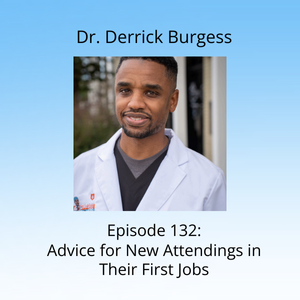
Ep 132: Advice for new attendings in their first job with Dr. Derrick Burgess
This episode discusses advice for new attending physicians starting at a new practice. It covers topics such as building relationships with colleagues and the community, understanding the practice's expectations, seeking mentorship, negotiating contracts, and handling job transitions or losses.
The key points include:
- Doing due diligence when choosing a job to ensure the practice aligns with expectations and can support the desired specialty.
- Being willing to say 'yes' to tasks outside one's specialty initially to build relationships and establish a patient base.
- Seeking mentorship from experienced colleagues, former attendings, or specialty organizations for guidance.
- Thoroughly reviewing employment contracts, understanding exit clauses, and negotiating favorable terms.
- Maintaining professionalism and building trust with the local community to attract patient referrals.
- Preparing for potential job changes or losses by understanding contract terms and having a support system.
- Exploring entrepreneurial pursuits like podcasting to combat burnout and find fulfillment outside clinical practice.The discussion provides valuable insights for new attendings navigating the challenges of starting a medical practice and building a successful career.

Ep 135: Pitfalls in joining a practice: Advice for both sides
Dr. Vertrees shares insights and tips from experienced surgeons on navigating the transition, building relationships, managing expectations, and finding success in the new role. Key topics covered include understanding cultural differences, communicating effectively, asking for help, time management, handling complications, building a referral base, and redefining success beyond just being a surgeon. The episode emphasizes the importance of open communication, setting boundaries, and embracing personal and professional growth throughout one's surgical career.
Chapters
Introduction
Dr. Vertrees introduces the topic of pitfalls when joining a new practice and shares her motivation for creating a self-coaching course called 'Become the Boss MD Self-Coaching.' She highlights the importance of learning lessons not taught in residency to become a successful surgeon.
Transitioning from Residency to Practice
The host discusses the fundamental differences between residency and a job, emphasizing the shift in rules, culture, support systems, and expectations. She encourages surgeons to embrace their ability to influence their experience positively, even if the job does not initially meet their expectations.
Asking for Help and Building Relationships
The article stresses the importance of asking for help and building relationships with colleagues, nurses, and staff. It provides advice from experienced surgeons on when and how to ask for help, as well as tips for senior attendings on supporting and encouraging new graduates.
Managing Expectations and Communicating Effectively
The article discusses the concept of 'want match,' where both parties' desires align, and offers strategies for managing expectations and communicating effectively with partners. It emphasizes the importance of open communication, setting boundaries, and understanding each other's perspectives.
Time Management and Efficiency
The article provides tips on time management, including prioritizing tasks, creating templates, and setting aside 'CEO time' for working on the business. It also stresses the importance of completing notes promptly to avoid burnout and maintain a good reputation.
Building a Referral Base and Marketing
The article offers advice on building a referral base, such as meeting with primary care physicians and gastroenterologists, sending letters about patient care, and understanding the referral patterns in the practice. It also suggests marketing strategies for new graduates.
Handling Complications and Building Trust
The article discusses the importance of being present and communicating openly with patients and families when complications arise. It provides strategies for building trust and maintaining a good reputation, such as following Brené Brown's steps for shame resilience.
Redefining Success and Personal Growth
The article encourages surgeons to redefine success beyond just being a surgeon and to embrace personal and professional growth throughout their careers. It emphasizes the importance of finding satisfaction in efforts, relationships, and the ability to help others, rather than solely focusing on work identity.
Closing Thoughts and Resources
The host concludes by emphasizing the value of coaching and self-coaching for surgeons, and mentions her book 'Become the Boss MD, Success Beyond Residency' and the upcoming 'Become the Boss MD Self-Coaching' course.
Action Items
- Head to bosssurgery.com to join the wait list for the Become the Boss MD Self-Coaching course, where there will be plenty of bonuses.
- Get the book 'Become the Boss MD, Success Beyond Residency' at bosssurgery.com or anywhere books are sold, like amazon.com.
- As a new graduate, ask for help as soon as you think it's the case, and don't hesitate to call your partners when you need assistance.
- As a senior partner, pop into the operating room to check on new graduates and offer help without waiting for them to call.
- Introduce new graduates to the staff and build them up, fostering a supportive environment.
- Create a list of equipment and preferences for cases, and communicate openly with partners about any changes or additions.
- Build relationships with primary care physicians, gastroenterologists, and other potential referral sources in the area.
- Send letters to referring providers about their patients' care and treatment plans to maintain communication and build trust.
- Set aside dedicated 'CEO time' to work on the business, improve efficiency, and plan for personal and professional growth.
- Complete notes promptly and efficiently to avoid burnout and maintain a good reputation within the practice.
- When complications arise, follow Brené Brown's steps for shame resilience: reach out to a trusted source, talk kindly to yourself, and own your story to maintain trust with patients and families.
- Redefine success beyond just being a surgeon, and embrace personal and professional growth throughout your career.
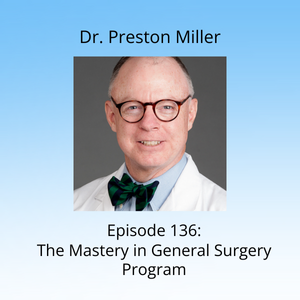
Ep 136 The Mastery in General Surgery program with Dr. Preston Miller
This episode talks about the Mastery in General Surgery program, which aims to provide advanced postgraduate training for surgeons interested in pursuing a career in general surgery. The program covers various aspects beyond clinical training, such as practice management, billing, legal issues, and the business side of surgery. Dr. Miller explains that the program is designed to address the shortage of general surgeons in the United States, particularly in rural and non-urban areas. He emphasizes that the program offers flexibility, allowing participants to tailor their training to their specific needs and interests. The program provides a safety net and mentorship for surgeons transitioning into practice, while also offering autonomy. Dr. Miller discusses the application process, program structure, curriculum, financing, and the benefits for both participants and hosting sites. The conversation also touches on the broader issue of maintaining competency and addressing gaps in surgical practice, highlighting the need for support and guidance within the surgical community.
For more information, head to Mastery in General Surgery Program
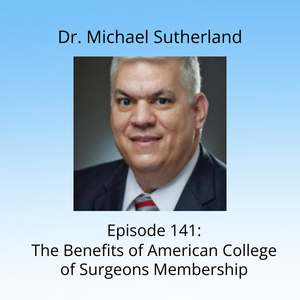
Episode 141: The benefits of American College of Surgeons membership with Dr. Michael Sutherland
Do you know all that the American College of Surgeons membership has to offer?
The latest BOSS podcast features Dr. Michael Sutherland, the Director of Membership Services of the American College of Surgeons (ACS). He talks about all that the ACS has to offer.
The ACS is the largest surgical organization in the world, representing over 92,000 members across 13 surgical specialties. Its mission is to safeguard the standards of surgical practice and elevate the quality of care through various programs, registries, and data-driven initiatives.
ACS membership includes access to discounted insurance programs, practice management resources, coding and reimbursement support, and personal financial management services. The ACS also plays a crucial role in advocacy and health policy, engaging with government agencies and insurance companies to shape policies that impact surgical practice.
Key recommendations are:
- Explore the ACS website (facs.org) and update your member dashboard to ensure your profile information is accurate and tailored to your surgical specialty and interests.
2. Bookmark and utilize the Surgical Risk Health Calculator available on the ACS website to facilitate informed discussions with patients about potential surgical outcomes based on real data.
3. Attend the annual Clinical Congress event to access cutting-edge education, vendor exhibits, surgical simulations, and networking opportunities with peers from around the world.
4. Investigate the various ACS podcasts, including 'House of Surgery,' 'Surgical Readings from SRGS,' and 'The Operative Word,' to stay updated on surgical topics and research.
5. Reach out to the ACS Member Services team ([email protected]) for assistance in finding resources or exploring opportunities to get involved with the organization.
6. Encourage medical students, residents, and younger surgeons to join the ACS and take advantage of the free membership during residency to experience the value proposition and resources available.

Episode 50: Crafting a powerful message with Dr. Dena George
Have you ever wondered why patients don't do what you say?
There is the message we give, and there is the message they receive.
How do we make sure that they hear our message?
Dr. Dena George is a family practice physician, StoryBrand certified marketing guide and creator of the "Create an Unstoppable Life" podcast, and Army veteran and founder of the Women Warrior Healers.
We had such a great conversation!
- A powerful message lets the patients buy in to their care
- We don't have to give all of the information to patients at once
- We can speak to their pain, and show how we can lessen it
- We can focus from right here and right now, not what they have done before
- The two things patients want to know: Do you understand my problem and can you help me?
- We put pressure on ourselves to know the right answer, even when it is not possible to know for sure
We also talked about:
- Crafting a powerful message on your website
- How she created an unstoppable life after she kept getting stuck
- Peace is an inside job
And we shared some of the powerful messages that we learned on deployment:
- How medical support conveys the message of hope and survival and critical to the war effort
- Remembering how much soldiers sacrificed
- Creating the Women Warrior Healers community
https://georgemdcoaching.com
https://georgemdcoaching.com/podcast
Episode 156: Getting the most out of conferences (without the drama) with Dr. Amy Vertrees
This podcast episode discusses strategies for making the most out of attending medical conferences as a surgeon. The host shares personal experiences and insights on preparing for conferences, managing thoughts and emotions, networking effectively, reflecting on career goals, and following up after the event. Key points include setting intentions beforehand, being mindful of self-talk, making meaningful connections, allowing for flexibility in plans, and practicing self-compassion throughout the experience.
Chapters
Introduction and Anticipation
The host introduces the topic of attending conferences and the mixed feelings of excitement and dread that often accompany them. She emphasizes the value of anticipating the event and enjoying the experience before, during, and after. Preparing for presentations and packing in advance can help reduce stress and allow for a more positive mindset.
Managing Thoughts and Emotions
The host acknowledges the various thoughts and emotions that can arise during conferences, such as self-doubt, imposter syndrome, and feelings of inadequacy. She encourages recognizing these as choices and practicing self-compassion. Strategies like setting deadlines, being present, and listening to one's body are recommended.
Networking and Connecting
Networking and making meaningful connections are highlighted as essential aspects of conferences. The host suggests preparing an elevator pitch, being open to new contacts, and following up after the event. Social media can also be a valuable tool for extending connections and promoting one's work.
Reflection and Career Goals
The host emphasizes the importance of reflecting on career goals and direction during and after conferences. Feelings of inspiration, intimidation, or discouragement can provide valuable feedback on desired growth areas. Gratitude and self-compassion are encouraged throughout the process.
Post-Conference Follow-Up
After the conference, the host recommends recording lessons learned, reviewing materials, completing CME requirements, submitting expenses for reimbursement, and scheduling a buffer day for reflection and recalibration. Proper follow-up can help maximize the benefits of attending the conference.
Action Items
- Set intentions and goals for the conference beforehand
- Prepare an elevator pitch for networking opportunities
- Practice self-compassion and manage self-talk during the conference
- Make an effort to connect with peers, mentors, and speakers
- Utilize social media to extend connections and promote your work
- Reflect on career goals and direction during and after the conference
- Record lessons learned and follow up on materials or connections
- Complete CME requirements and submit expenses for reimbursement
- Schedule a buffer day for reflection and recalibration after the conference
In this episode, Dr. Amy Vertrees breaks down the most common—and costly—mistakes surgeons make when transitioning from residency to independent practice.
Medical training prepares physicians to be excellent employees inside hierarchical systems. But the moment residency ends, surgeons must suddenly step into leadership roles — becoming the CEO of their own careers, practices, and professional futures.
This episode serves as both a roadmap and mindset reset for new attendings navigating autonomy, responsibility, leadership, and long-term career sustainability.
The Core Problem: From Employee → Leader
Throughout training, physicians are conditioned to:
- Follow systems created by others
- Meet externally defined metrics
- Wait for approval before acting
New attendings quickly discover that success now requires:
✅ Independent decision-making
✅ Leadership skills
✅ Delegation and team management
✅ Ownership of career direction
Being “the boss” does not mean being domineering—it means intentionally leading your career.
Key Lessons From This Episode
1. Become the Boss of Your Career
You are no longer being managed—you are managing:
- Your operating room
- Your clinic flow
- Your professional growth
- Your long-term career trajectory
Leadership is a learned skill, not an innate personality trait.
2. Delegation Is a Clinical Skill
Dr. Vertrees explains the five levels of delegation and why misaligned expectations create friction.
High-functioning teams require:
- Clear instructions
- Defined autonomy levels
- Anticipation of next steps
- Psychological safety for staff
Receiving help is as important as giving direction.
3. Reduce Mental Load to Improve Performance
Small decisions accumulate into massive cognitive burden.
Practical strategies:
- Create detailed preference cards
- Write procedure steps beforehand
- Build predictable workflows
- Organize systems so your team can anticipate needs
Less mental clutter → smoother cases → better leadership presence.
4. Understand Your Stress Response
New roles trigger fear—even in highly competent surgeons.
Common responses include:
- Fight – irritability or hostility
- Flight – avoidance or procrastination
- Freeze – showing up but underperforming
- Fawn – over-agreeing to avoid conflict
Both overworking and underworking can be fear responses.
5. Planning Is a Leadership Skill
Successful attendings plan for results, not activities.
Examples:
- Pre-complete clinic notes
- Block time for outcomes, not tasks
- Include preparation and documentation time in schedules
Planning reduces overwhelm and protects cognitive energy.
6. Emotional Capacity Determines Career Longevity
Dr. Vertrees introduces emotional capacity as the professional equivalent of physiologic reserve.
Building emotional capacity allows surgeons to balance:
- stress
- uncertainty
- complications
- administrative pressure
Skills like courage, pride, and purpose expand resilience.
7. Escape the Perfectionist Trap
Physicians often operate in maladaptive perfectionism.
Instead, use Gain vs. Gap Assessment:
- Identify three things that went well
- Then evaluate improvement opportunities
Assessment builds confidence while sustaining growth.
8. Professional Reality: Someone Is Always Watching
Peer review, administration, and legal oversight are constants.
The goal:
- Maintain authenticity
- Practice professional integrity
- Document as if notes will be immediately reviewed
Awareness—not fear—creates strong professional presence.
9. Relationships Are Emotional, Not Logical
Drawing on insights echoed by Maya Angelou, people remember how you make them feel more than what you say.
Key principles:
- Don’t trust blindly
- Avoid paranoia
- Lead interactions with emotional intelligence
10. Negotiation Is About Emotion
Inspired by negotiation expert Chris Voss, Dr. Vertrees recommends entering difficult conversations assuming:
👉 You are missing important information.
Curiosity creates safety, and safety unlocks productive negotiation.
11. Rethinking Money and Career Sustainability
Financial anxiety often drives burnout decisions.
Framework:
Value → Money → Desired Outcome
Sometimes you can bypass money entirely by using your value to gain:
- Time
- Flexibility
- Security
- Autonomy
Think in decades, not contracts.
The Bigger Message
Don’t miss the point of your career.
Medicine should provide:
- Meaning
- Purpose
- Contribution
- Sustainability
A successful career is not just surviving medicine—it’s designing a life that works.
Interactive Discussion Highlights
Participants shared real-world challenges including:
- Maintaining authenticity in unsupportive environments
- Navigating workplace politics
- Administrative decisions affecting patient care
- Learning to investigate systems instead of internalizing blame
Actionable Takeaways
- Create OR preference cards and procedure checklists
- Write procedure steps before cases
- Plan weekly schedules based on outcomes and feelings
- Pre-complete clinic documentation when possible
- Perform regular Gain vs. Gap self-assessments
- Document patient gratitude to maintain perspective
- Write notes assuming immediate review
Upcoming Opportunities
📅 Free Career Protection Call — April 14 at 6 PM Central
Featuring healthcare attorney Amanda Hill
Register HERE:
https://us02web.zoom.us/webinar/register/WN_QfkL13UNQCC3avfp-jZdCg
Topics include:
- Contract awareness
- Legal protections
- Exit strategy planning
- Career security
After a decade in private practice, Dr. Claudia Emami transitioned from pediatric surgeon to Chief Medical Officer—driven by burnout and a deep curiosity about how healthcare systems function.
In this episode, she shares the behind-the-scenes structure of hospital operations that every surgeon should know but rarely learns in training.
We cover:
-
The difference between medical staff and hospital administration
-
Why bylaws are your protection
-
How credentialing and peer review actually work
-
Who sits in the C-suite—and what they control
-
Why surgeons should proactively build relationships with their CMO and chief of staff
-
How committee participation builds influence and opportunity
Healthcare is becoming increasingly complex. Mergers, acquisitions, and system growth mean that physicians who don’t understand governance risk losing their voice.
This episode is a practical roadmap for surgeons who want to protect their autonomy, navigate hospital politics wisely, and possibly even explore leadership beyond the OR.
What New Attendings Need to Know About Credentialing, Peer Review, and Protecting Your Career
Guest: Dr. Claudia Emami
Starting your first job as an attending physician involves navigating systems that residency rarely teaches you about. In this episode, Dr. Claudia Emami joins the BOSS Business of Surgery Series to explain how hospital credentialing works, how peer review actually functions, and what physicians should understand to protect their careers.
Dr. Emami walks through the credentialing process required for physicians who want to practice in hospitals, including verification of training, licensure, malpractice history, and case logs. For surgeons and proceduralists, documenting recent cases is essential, and when case volume is insufficient, hospitals may require proctoring before granting full privileges.
A key point discussed in the episode is that having a job contract does not guarantee hospital privileges. Credentialing is a separate process that must be approved by the hospital’s credentialing committee and medical staff leadership.
The conversation also explores Ongoing Professional Practice Evaluation (OPPE) and Focused Professional Practice Evaluation (FPPE)—the systems hospitals use to review complications, outcomes, and performance trends. These processes feed into broader reporting systems, including the National Practitioner Data Bank.
Dr. Emami explains how peer review works when complications occur and outlines how concerns may escalate through departmental review, quality committees, and medical staff leadership. In more serious situations, physicians may face additional proctoring, monitoring, or privilege restrictions.
The episode also addresses professional realities that new attendings often overlook—such as the importance of building relationships throughout the hospital. Developing strong connections with the chair of surgery, chief medical officer, medical staff office, and OR teams can be critical to navigating complex situations.
Finally, Dr. Emami emphasizes professional resilience. Career challenges, complications, and difficult reviews happen to nearly every surgeon at some point. Understanding the systems, participating in peer review, and maintaining perspective can help physicians recover from setbacks and continue to build successful careers.
Key Takeaways
-
A signed job contract does not guarantee hospital privileges
-
Surgeons must maintain accurate case logs and documentation
-
Proctoring is common and often required when privileges are new
-
Physicians should understand peer review, OPPE, and FPPE processes
-
Strong professional relationships within the hospital are essential
-
Setbacks in credentialing or peer review are challenging but not career-ending
This meeting record transcript is a conversation between a host and Dr. Michael Sutherland, the membership director of the American College of Surgeons (ACS). The discussion covers various aspects of the ACS, including its mission, membership benefits, educational resources, advocacy efforts, international outreach programs, and the annual Clinical Congress event. Dr. Sutherland shares his personal journey of getting involved with the ACS as a resident and highlights the opportunities for surgeons at different career stages to participate and contribute to the organization. He emphasizes the value proposition of ACS membership, which includes access to discounted insurance programs, practice management resources, coding and reimbursement support, and personal financial management services. The ACS is described as the largest surgical organization in the world, representing over 92,000 members across 13 surgical specialties. Its mission is to safeguard the standards of surgical practice and elevate the quality of care through various programs, registries, and data-driven initiatives. The organization also plays a crucial role in advocacy and health policy, engaging with government agencies and insurance companies to shape policies that impact surgical practice. Internationally, the ACS has chapters in over 120 countries and runs programs like ACS HOPE (Health Outreach in Underserved Areas) to enhance surgical education and workforce development in underserved regions. The annual Clinical Congress event is highlighted as a premier educational and networking opportunity, offering cutting-edge education, vendor exhibits, surgical simulations, and social networking events. Overall, the conversation aims to raise awareness about the extensive resources and benefits available to ACS members, encouraging surgeons, particularly younger ones, to get involved and take advantage of the organization's offerings.
Chapters
Dr. Sutherland's Journey with the ACS 00:01:10
Dr. Sutherland shares his personal journey of getting involved with the ACS as a resident when the 80-hour work week was implemented. He started participating in discussions and committees, eventually becoming the chair of the Resident Associate Society and the Young Fellows Association. He emphasizes that the ACS offers opportunities for passionate individuals to engage and contribute to improving patient care and surgical quality.
The Value Proposition of ACS Membership 00:18:22
Dr. Sutherland highlights various benefits and resources available to ACS members, including discounted insurance programs (life, disability, accidental death), practice management materials, contract negotiation services, personal financial management resources, coding and reimbursement support, and access to data-driven initiatives like surgical risk calculators. The goal is to provide value-added benefits that make ACS membership a worthwhile investment for surgeons.
The ACS as the House of Surgery 00:08:33
The ACS is described as the largest surgical organization in the world, representing over 92,000 members across 13 surgical specialties. Its mission is to safeguard the standards of surgical practice and elevate the quality of care through various programs, registries, and data-driven initiatives. The organization has a strong voice in advocacy and health policy discussions, shaping policies that impact surgical practice.
International Outreach and Education 00:11:29
The ACS has chapters in over 120 countries and runs programs like ACS HOPE (Health Outreach in Underserved Areas) to enhance surgical education and workforce development in underserved regions. The program has training hubs in countries like Ethiopia, Rwanda, and Zambia, where attending physicians and residents from the U.S. help educate local surgeons and build self-sustaining surgical capabilities.
The Annual Clinical Congress 00:29:07
The Clinical Congress is highlighted as the premier event for the ACS, offering cutting-edge education from subject matter experts, vendor exhibits, surgical simulations, and social networking opportunities. Dr. Sutherland emphasizes the importance of networking and building lasting connections with peers at the event. The Congress also features named lectures, convocation ceremonies, and cultural experiences like the "Taste of the City" event.
Engaging Younger Surgeons 00:41:12
Dr. Sutherland acknowledges the challenge of communicating the value proposition of ACS membership to younger surgeons, particularly residents and fellows. The organization aims to eliminate cost barriers by offering free membership during residency and highlighting the various resources and opportunities available to engage and contribute to the ACS at different career stages.
Action Items
- Explore the ACS website (facs.org) and update your member dashboard to ensure your profile information is accurate and tailored to your surgical specialty and interests. 00:37:04
- Bookmark and utilize the Surgical Risk Health Calculator available on the ACS website to facilitate informed discussions with patients about potential surgical outcomes based on real data. 00:39:09
- Attend the annual Clinical Congress event to access cutting-edge education, vendor exhibits, surgical simulations, and networking opportunities with peers from around the world. 00:31:26
- Investigate the various ACS podcasts, including 'House of Surgery,' 'Surgical Readings from SRGS,' and 'The Operative Word,' to stay updated on surgical topics and research. 00:46:01
- Reach out to the ACS Member Services team ([email protected]) for assistance in finding resources or exploring opportunities to get involved with the organization. 00:43:42
- Encourage medical students, residents, and younger surgeons to join the ACS and take advantage of the free membership during residency to experience the value proposition and resources available. 00:41:46
BOSS Business of Surgery Series – Episode 201
Getting the Most Out of Conferences Without the Drama
In this episode of the BOSS Business of Surgery Series, Dr. Amy Vertrees shares a replay of an episode recorded on her way to the Association of Women Surgeons and American College of Surgeons conferences.
Conferences can be some of the most valuable experiences in a surgical career. They offer education, innovation, networking, reconnection, inspiration, and career opportunities. They can also bring up a surprising amount of mind drama: comparison, self-doubt, guilt, pressure, intimidation, and the feeling that everyone else is further ahead.
Dr. Vertrees walks through how to approach conferences with more intention before, during, and after the event so surgeons can get more value from the experience without getting buried in drama.
In this episode, you’ll learn:
- Why conferences are valuable for learning, connection, networking, and career growth
- How paying your own way can change the level of intention you bring to an event
- Why anticipation is part of the value of attending a conference
- How to plan ahead instead of waiting until the flight to think about the meeting
- Why presentations feel better when you create mini-deadlines instead of relying on last-minute pressure
- How to decide what you want most from a conference before you arrive
- Why some sessions may be better watched on replay while in-person time is used for connection
- How networking can support your future career in ways you cannot predict
- Why surgeons may feel both inspired and intimidated in the same conference environment
- How to recognize comparison thoughts without letting them drive your experience
- Why self-compassion is essential when you feel awkward, insecure, or out of place
- How to manage your energy, food, hydration, alcohol, sleep, and overstimulation during meetings
- Why many surgeons may find “performing” socially more draining than operating
- How an elevator pitch can make conference conversations easier and more effective
- Why social media can extend the value and reach of your conference experience
- How exhibits can reveal trends in medicine, hiring, locums, technology, and practice opportunities
- Why reflection after the conference helps you extract the real lessons
- How to handle guilt about being away from family
- Why a buffer day after travel can be part of honoring the conference experience
Key themes:
- Conference planning with intention
- Networking without self-doubt
- Comparison and mind drama
- Self-compassion in professional spaces
- Presenting without panic
- Energy management during travel
- Career reflection and growth
- Social media as connection
- Family guilt and professional development
- Getting value before, during, and after the event
Practical strategies discussed:
- Think about the conference before you go so you can enjoy the anticipation
- Identify your top priorities: learning, networking, presenting, reconnecting, or promotion
- Review the agenda and decide what must be attended live
- Use replays strategically when available
- Create mini-deadlines for presentations, including outline, resources, slides, and submission
- Pack early and plan intentionally
- Bring business cards or an easy way to exchange contact information
- Prepare a short elevator pitch for different types of people you may meet
- Notice thoughts like “they don’t want to talk to me” or “I’m not ready” without obeying them
- Decide ahead of time how you want to handle food, alcohol, hydration, movement, and sleep
- Post useful insights or connections on social media when it feels aligned
- Follow up with people you want to collaborate with or stay connected to
- Set aside time after the conference to reflect on lessons learned
- Put missed recordings on your calendar
- Complete CME promptly
- Save receipts and submit reimbursement early
- Consider scheduling a buffer day before returning fully to work
Resources mentioned:
- Association of Women Surgeons Conference
- American College of Surgeons Conference
- Become the Boss MD Facebook group
- BOSS Podcast Guide
- Boss Business of Surgery Series: https://bossurgery.com
This episode is a practical guide for surgeons who want conferences to feel less like pressure and more like possibility. Dr. Vertrees’ message is clear: when you plan intentionally, manage your mind, and honor your energy, conferences can become a powerful source of connection, inspiration, and career growth without all the unnecessary drama.
This meeting record transcript is a conversation between a host and Dr. Michael Sutherland, the membership director of the American College of Surgeons (ACS). The discussion covers various aspects of the ACS, including its mission, membership benefits, educational resources, advocacy efforts, international outreach programs, and the annual Clinical Congress event. Dr. Sutherland shares his personal journey of getting involved with the ACS as a resident and highlights the opportunities for surgeons at different career stages to participate and contribute to the organization. He emphasizes the value proposition of ACS membership, which includes access to discounted insurance programs, practice management resources, coding and reimbursement support, and personal financial management services. The ACS is described as the largest surgical organization in the world, representing over 92,000 members across 13 surgical specialties. Its mission is to safeguard the standards of surgical practice and elevate the quality of care through various programs, registries, and data-driven initiatives. The organization also plays a crucial role in advocacy and health policy, engaging with government agencies and insurance companies to shape policies that impact surgical practice. Internationally, the ACS has chapters in over 120 countries and runs programs like ACS HOPE (Health Outreach in Underserved Areas) to enhance surgical education and workforce development in underserved regions. The annual Clinical Congress event is highlighted as a premier educational and networking opportunity, offering cutting-edge education, vendor exhibits, surgical simulations, and social networking events. Overall, the conversation aims to raise awareness about the extensive resources and benefits available to ACS members, encouraging surgeons, particularly younger ones, to get involved and take advantage of the organization's offerings.
Chapters
Dr. Sutherland's Journey with the ACS 00:01:10
Dr. Sutherland shares his personal journey of getting involved with the ACS as a resident when the 80-hour work week was implemented. He started participating in discussions and committees, eventually becoming the chair of the Resident Associate Society and the Young Fellows Association. He emphasizes that the ACS offers opportunities for passionate individuals to engage and contribute to improving patient care and surgical quality.
The Value Proposition of ACS Membership 00:18:22
Dr. Sutherland highlights various benefits and resources available to ACS members, including discounted insurance programs (life, disability, accidental death), practice management materials, contract negotiation services, personal financial management resources, coding and reimbursement support, and access to data-driven initiatives like surgical risk calculators. The goal is to provide value-added benefits that make ACS membership a worthwhile investment for surgeons.
The ACS as the House of Surgery 00:08:33
The ACS is described as the largest surgical organization in the world, representing over 92,000 members across 13 surgical specialties. Its mission is to safeguard the standards of surgical practice and elevate the quality of care through various programs, registries, and data-driven initiatives. The organization has a strong voice in advocacy and health policy discussions, shaping policies that impact surgical practice.
International Outreach and Education 00:11:29
The ACS has chapters in over 120 countries and runs programs like ACS HOPE (Health Outreach in Underserved Areas) to enhance surgical education and workforce development in underserved regions. The program has training hubs in countries like Ethiopia, Rwanda, and Zambia, where attending physicians and residents from the U.S. help educate local surgeons and build self-sustaining surgical capabilities.
The Annual Clinical Congress 00:29:07
The Clinical Congress is highlighted as the premier event for the ACS, offering cutting-edge education from subject matter experts, vendor exhibits, surgical simulations, and social networking opportunities. Dr. Sutherland emphasizes the importance of networking and building lasting connections with peers at the event. The Congress also features named lectures, convocation ceremonies, and cultural experiences like the "Taste of the City" event.
Engaging Younger Surgeons 00:41:12
Dr. Sutherland acknowledges the challenge of communicating the value proposition of ACS membership to younger surgeons, particularly residents and fellows. The organization aims to eliminate cost barriers by offering free membership during residency and highlighting the various resources and opportunities available to engage and contribute to the ACS at different career stages.
Action Items
- Explore the ACS website (facs.org) and update your member dashboard to ensure your profile information is accurate and tailored to your surgical specialty and interests. 00:37:04
- Bookmark and utilize the Surgical Risk Health Calculator available on the ACS website to facilitate informed discussions with patients about potential surgical outcomes based on real data. 00:39:09
- Attend the annual Clinical Congress event to access cutting-edge education, vendor exhibits, surgical simulations, and networking opportunities with peers from around the world. 00:31:26
- Investigate the various ACS podcasts, including 'House of Surgery,' 'Surgical Readings from SRGS,' and 'The Operative Word,' to stay updated on surgical topics and research. 00:46:01
- Reach out to the ACS Member Services team ([email protected]) for assistance in finding resources or exploring opportunities to get involved with the organization. 00:43:42
- Encourage medical students, residents, and younger surgeons to join the ACS and take advantage of the free membership during residency to experience the value proposition and resources available. 00:41:46
How do surgery residents find their first job—and keep it? In this episode, Dr. Amy Vertrees sits down with Dr. Sharon Stein, a colorectal surgeon turned professional development coach, to talk about her new program designed to help residents land jobs that truly fit their goals and values.
Dr. Stein shares eye-opening statistics:
-
15% of surgeons leave their first job within 2 years.
-
50% leave within 5 years.
The problem? Training programs teach standardized skills but don’t help surgeons identify their unique strengths—or what they really want in a job.
Together, Dr. Vertrees and Dr. Stein discuss:
✅ Why comparison (not competition) derails job searches
✅ The mid-career slump and how to prevent it
✅ A 4-step framework for assessing, interviewing, evaluating, and negotiating job offers
✅ How institutions (and surgeons) can avoid the high cost of misaligned job placements
Dr. Stein’s new six-month program includes on-demand modules, group coaching, and one-on-one sessions—limited to 30 graduates across all surgical specialties.
🔑 Key Takeaways
-
Clarity comes first: Identify negotiables and non-negotiables before interviewing.
-
It’s not just salary: Evaluate culture, mentorship, and long-term growth.
-
Negotiation = relationship building, not confrontation.
-
Coaching isn’t just for the lost— it’s for creating sustainable, fulfilling careers.
📌 Resources & Links
-
Learn more about Dr. Sharon Stein: theintentionalsurgeon.com
-
Access her free Launch Pad Checklist here:https://sharon-stein.mykajabi.com/opt-in
✨ If you’re a surgical resident—or know one—this episode is a must-listen for setting up a thriving career from the start.
Dr. Amy Vertrees, a surgeon, author, podcast host, and certified coach, delivered the first session of a launch week series aimed at new attending physicians. The presentation focused on common mistakes new attendings make and strategies to avoid them. Dr.Vertrees emphasized that the information shared was based on her own experiences and lessons learned throughout her career.
Dr.Vertrees began by outlining the week-long series of presentations, which would cover topics including office manager insights, money management for physicians, handling complications, legal risks, time management, and efficient note-taking. She emphasized that these sessions were designed to be interactive, encouraging participants to ask questions through chat or Q&A features.
A central theme of Dr.Vertrees' presentation was the importance of mastery and recognition for job satisfaction. She explained that mastery means being good at one's job, while recognition involves being acknowledged for one's skills and contributions. Dr.Vertrees noted that this formula applies not only to physicians but to everyone in the workplace, highlighting the importance of recognizing others' contributions and allowing them to develop mastery in their roles.
Dr.Vertrees discussed the significance of understanding organizational culture, including the mission, beliefs, and values of one's workplace. She advised new attendings to consider whether their personal values align with their organization's culture, as misalignment can lead to dissatisfaction. She also emphasized that new physicians bring valuable perspectives and should feel confident in suggesting changes, though she recommended approaching such suggestions carefully by first asking questions to understand existing practices.
The presentation covered strategies for dealing with difficult colleagues, emphasizing that communication breakdowns can make any colleague difficult. Dr.Vertrees offered practical advice for improving interactions, including focusing on what people actually say rather than interpretations, examining what meaning one assigns to others' words, and understanding one's own stress responses (fight, flight, freeze, or fawn). She suggested that recognizing these patterns in oneself can help in understanding others' behaviors as well.
Dr.Vertrees addressed the topic of being reported or receiving negative feedback, advising attendees to view such situations as opportunities for growth rather than threats. She emphasized the importance of participating in leadership positions and committees to have influence in one's organization, noting that "you're either at the table or you're on the menu."
The presentation also covered personal development topics such as overcoming imposter syndrome, which Dr.Vertrees defined as feeling inadequate despite demonstrated success. She offered strategies for challenging negative thoughts by turning statements into questions and comparing oneself to past versions rather than to others. Dr.Vertrees distinguished between confidence (which comes from repeated experience) and self-confidence (the courage to act despite fear).
Dr.Vertrees discussed the importance of marketing oneself effectively, emphasizing that marketing involves knowing one's values and being authentic. She encouraged attendees to embrace their unique qualities rather than conforming to stereotypical surgeon personas. She also addressed the topic of getting paid appropriately, emphasizing the importance of timely documentation, proper coding, and understanding the revenue cycle.
The presentation concluded with advice on tracking various aspects of one's practice, including finances, cases, clinic metrics, and complications. Dr.Vertrees stressed the importance of adapting to life changes and having contingency plans, including knowing one's contract details and having an exit strategy. She offered strategies for dealing with negative emotions, particularly shame, and emphasized the importance of seeking help when needed.
Throughout the presentation, Dr.Vertrees maintained that physicians should give themselves permission to quit if necessary, while also finding purpose in their work. She concluded by emphasizing treatments that address root problems, including therapy, coaching, journaling, community support, and sometimes medications.
Chapter
Introduction to Launch Week for New Attendings 00:00:02
Dr. AmyVertrees welcomed participants to the first day of launch week, designed specifically for new attending physicians. She explained that the purpose of these sessions was to share information she wished she had known when starting as a new attending. Dr.Vertrees encouraged interaction through chat or Q&A features and introduced herself as a surgeon, author, podcast host, and certified coach. She outlined the week's topics, including office manager insights, money management, handling complications, legal risks, time management, and efficient note-taking.
Mastery and Recognition: The Key to Job Satisfaction 00:03:20
Dr.Vertrees identified mastery and recognition as the fundamental elements of job satisfaction. She defined mastery as being good at one's job and recognition as being acknowledged for one's skills and contributions. She emphasized that this formula applies to everyone in the workplace and highlighted the importance of recognizing others' contributions. Dr.Vertrees cautioned against the mistake of doing everything oneself, as this robs others of the opportunity to develop mastery and receive recognition.
Understanding Organizational Culture 00:05:28
Dr.Vertrees discussed the importance of understanding the culture of one's organization, including its mission, beliefs, and values. She advised attendees to consider whether their personal values align with their organization's culture, noting that misalignment becomes evident over time. Dr.Vertrees emphasized that new physicians bring valuable perspectives and should feel confident in suggesting changes, though she recommended approaching such suggestions carefully by first asking questions to understand existing practices.
Navigating Difficult Colleagues and Communication 00:07:46
Dr.Vertrees addressed the challenge of difficult colleagues, noting that communication breakdowns can make any colleague difficult. She offered practical advice for improving interactions, including focusing on what people actually say rather than interpretations, examining what meaning one assigns to others' words, and understanding one's own stress responses (fight, flight, freeze, or fawn). She suggested that recognizing these patterns in oneself can help in understanding others' behaviors as well.
Handling Reports and Feedback 00:11:52
Dr.Vertrees discussed how to handle situations where one is reported or receives negative feedback. She advised viewing such situations as opportunities for feedback rather than threats, noting that a report simply generates paperwork that someone needs to address. She emphasized the importance of maintaining a good headspace to respond appropriately, whether the feedback indicates an area for personal improvement or a situation to be cautious about.
Participating in Organizational Leadership 00:13:31
Dr.Vertrees emphasized the importance of participating in leadership positions and committees to have influence in one's organization, stating "you're either at the table or you're on the menu." She encouraged attendees to get involved at hospital, state, or national levels, while being selective about which positions to take on. Dr.Vertrees advised being clear about one's motivations for taking on leadership roles and understanding that such roles are often what one makes of them.
Creating Personal Safety and Understanding Values 00:15:18
Dr.Vertrees discussed the importance of understanding one's personal culture and values, especially when working in a difficult organizational culture. She emphasized that clarity about one's values helps in making decisions and recommended values exercises to gain self-awareness. Dr.Vertrees addressed the concept of scarcity, noting that feelings of not having enough can trigger unhelpful "hustle" behaviors and that new physicians may trigger scarcity feelings in established colleagues.
Establishing Boundaries 00:18:32
Dr.Vertrees outlined five steps for establishing effective boundaries: defining the boundary, communicating it to relevant parties, outlining consequences for boundary violations, enforcing those consequences, and allowing oneself to make exceptions when appropriate. She used the example of after-hours patient calls to illustrate these steps, emphasizing that a boundary isn't truly established unless all five steps are followed.
Addressing Imposter Syndrome 00:21:09
Dr.Vertrees defined imposter syndrome as feeling inadequate despite demonstrated success, a phenomenon first identified in high-achieving women in academia in 1978. She explained that people with imposter syndrome have negative thoughts despite outward success, making it difficult for others to understand or help. Dr.Vertrees suggested turning negative statements into questions to challenge these thoughts, such as changing "I'm not doing this right" to "Am I okay?"
Challenging Common Negative Thoughts 00:24:50
Dr.Vertrees identified common negative thoughts that high-achieving people experience, including fears of being perceive
The episode focused on the concept of being a “slow surgeon” and how surgeons can manage performance, confidence, and perception in the operating room.
Amy Vertrees, MD began by exploring what “slow” means in a surgical context. She encouraged participants to examine whether slowness is an objective measure, a feeling, or a comparison to others. Participants noted that perceived slowness can be influenced by system constraints, knowledge gaps, skill development, self-talk, and the expectations of other people in the room.
Dr. Vertrees emphasized that the perception of speed is not only internal. It is also shaped by how others experience the surgeon’s performance. She discussed how tools such as the Da Vinci robot can provide performance metrics that may either confirm or contradict a surgeon’s personal perception of speed.
A significant portion of the session focused on mindset and thought patterns. Dr. Vertrees introduced the thought model, which is based on cognitive behavioral therapy, and explained how facts trigger thoughts, which create emotions and ultimately influence actions. She emphasized the importance of identifying unhelpful thoughts, reframing negative self-talk, and learning how to manage both internal criticism and external feedback.
The presentation included practical strategies for building confidence, including mental rehearsal, grounding statements, team briefing, and deliberate performance tracking. Dr. Vertrees also discussed self-compassion and the importance of accepting that mistakes and discomfort are part of the learning process.
The session concluded with information about a coaching program designed to help surgeons navigate challenges such as complications, difficult colleagues, confidence issues, and practice management.
Chapters
Understanding the Concept of “Slow” in Surgery
00:00:16
Amy Vertrees, MD opened the session by asking participants to consider what it means to be a “slow surgeon.” The discussion explored slowness as both a measure of time and a feeling. Participants noted that speed is often judged in comparison to others and may be affected by workflow, experience, system limitations, and self-perception.
The Impact of Mindset in the Operating Room
00:02:36
Dr. Vertrees discussed how mindset influences surgical performance. She emphasized that a surgeon’s thoughts can shape their behavior, confidence, communication, and experience in the OR. She also explored the difference between a surgeon’s personal opinion of their performance and the way others may perceive them.
Managing Internal and External Perceptions
00:04:04
This section focused on how surgeons can manage both internal dialogue and external feedback. Dr. Vertrees discussed reframing unhelpful thoughts, responding to criticism constructively, and recognizing that perception can be influenced over time through communication, preparation, and consistent action.
Building Confidence Through Preparation
00:12:19
Dr. Vertrees presented strategies for building confidence by assessing current reality, identifying desired outcomes, and creating specific goals. She encouraged surgeons to consider both their own confidence and the confidence others have in them, especially when working with learners, fellows, or colleagues.
Practical Tools for Improvement
00:54:52
Dr. Vertrees introduced practical tools for improving surgical performance and confidence, including mental rehearsal, grounding statements, team communication, and intentional pre-operative preparation. These tools help surgeons enter the OR with greater clarity, focus, and emotional regulation.
Action Items
- Implement a performance dashboard to track surgical steps, confidence levels, and areas for improvement. 00:29:06
- Develop clear communication and boundaries when working with fellows. 00:14:02
- Create specific benchmarks for both personal performance and fellow training. 00:14:55
- Use pre-operative mental rehearsal with clear time boundaries. 00:51:05
- Develop grounding statements to manage thoughts and emotions in the OR. 00:51:59

In this episode of the BOSS Business of Surgery Series, we dive into the journey behind the third edition of a widely used surgical textbook. Dr. Mark Neff, the book’s original author, shares how failing his oral board exam inspired him to create a resource that has since transformed surgical education. Joined by Dr. Kay Yoon-Flanery, a fellowship-trained breast surgeon, and Dr. Ashanti Ratnasekera, a trauma and acute care surgeon, the discussion explores the book’s impact, the role of mentorship, and the lessons learned from the oral board experience.
Key Topics Discussed:
🔹 From Failure to Foundation: Dr. Neff’s journey from failing the oral boards to publishing a comprehensive surgical textbook, initially rejected by multiple publishers before Springer accepted it.
🔹 The Book’s Evolution: How it grew from a simple study guide to a 518-page resource featuring contributions from over 150 authors.
🔹 Mentorship & Support in Surgery: Dr. Yoon-Flanery shares her experiences as a resident navigating pregnancy, with Dr. Neff as a key mentor. Dr. Ratnasekera reflects on how his teaching shaped her approach to minimally invasive surgery.
🔹 Lessons from the Oral Boards: The guests discuss their own exam experiences, including the importance of preparation and focusing on "horses" (common cases) rather than "zebras" (rare ones).
🔹 Future Goals: Expanding the book’s reach beyond surgery, increasing diversity among contributors, and ensuring integrity by keeping board examiners out of the author pool.
This episode is a powerful reminder that failure isn’t the end—it’s often the beginning of something greater. Tune in to hear how persistence, collaboration, and mentorship are shaping the future of surgical education.
Meet Your Host
Amy Vertrees, MD is a board-certified general surgeon, certified coach, and the founder and host of the BOSS Business of Surgery Series podcast — a show dedicated to helping surgeons build confidence, clarity, and control in their careers by mastering the skills residency never taught them. After completing surgical training and serving in the military, Amy realized that clinical excellence alone wasn’t enough to navigate the complexities of contracts, practice dynamics, negotiation, and career growth. What started as her personal journey to learn “what’s next” transformed into a mission to empower fellow surgeons with the tools to thrive both professionally and personally. .
Learn More >